As I continued meditating on what it means that God wants to
strengthen his children with all power, it became very clear that our
weaknesses are not in the way of what he wants to do. It is our willingness to
seek his strength that determines how well we join him in his work.
Here is a look at the meaning of “strengthened with all
power”[1]
with a view to understanding and appreciating how both the strength and the
power are of the Lord Jesus Christ. We are able to be strong in him if we
humble ourselves and pray for his strength to be perfected in our weakness.
Again, because this is the will of God, we can trust God to do this for
everyone who asks in Jesus’ name.
[1]
Colossians 1:11 (in the context of Paul’s prayer of Colossians 1:9-14)
So often in my sharing about God’s word, I find myself eager
to share both the general picture of how everyone can get to know God in his word,
and the specific testimony about what I just learned that day that illustrates
this point.
This Vlog aims to accomplish both desires. The general
picture is in how God’s word is like discovering hidden treasures, and the specific
testimony is how God used a number of these treasures to encourage me to pray that
we would be “strengthened with all power” in our living for Christ.[1]
Not only did I see why this prayer is so important, but I
also saw how God will answer us even as we are praying through his word! I do
have the advantage of age where our natural decline in physical strength does
seem to have an encouraging effect on our spiritual strength. However, this
certainly applies to all God’s children no matter our age.
It was one of those mornings where my eyes popped open earlier
than my alarm and I had to ask our Father in heaven whether there was anyone in
my life who needed prayer right then. While some people came to mind to pray
for, I mostly had a sense that I was to pray through the Beatitudes of Matthew
5:1-12 and seek God to make those things real for everyone in my life.
As I was praying, I became overwhelmed with the awareness of
two things. One was the way God was blessing me in my praying, and the other
was in the consideration of what Jesus had to do so my prayers could be
answered. I was so blessed in the things our Father was teaching me, and so
glad I could share them with you while out on my truck route prayer walk.
The more I learn about prayer, the more I realize that God
isn’t nearly as interested in my ideas for fixing things as I once imagined. Or,
perhaps I never even imagined that he was interested because I was too busy
being interested in my own ideas myself! Whatever the case, God has been
working on me to stop trying to figure out and fix things, but to pray the way
the apostle Paul has been teaching me in Colossians 1:9-14.
On the Saturday of Easter weekend 2022 I fulfilled a long-time
desire to hike a particular backroad that carved its way along the hillside to
the northeast of our community.
I enjoyed sight of a number of mule deer,
and discovered
a part of the range land where blue birds seemed to be in abundance.
Along the way I was pondering the things God had taught me
earlier in my time alone with him in his word. I was quite sure I’m not the
only one who has a propensity to struggle with prayer while having no problem
coming up with my own ideas of what I should do.
Since God was making the
difference so clear to me, it was easy to share these things in a video that
might encourage you as well.
I am all
for making the most of the fellowship and witnessing we can do on social media.
I like to hear what God is doing in other places and in other situations. I
like to share things to encourage the children of God, and I like to share
things that help people consider the good news of great joy that is all about
our Savior, Jesus the Christ.
However,
there are times when it feels overwhelming to hear of another disaster ruining
lives, or another wave of persecution decimating the Christian population of an
area. It is overwhelming to consider one prayer request after another to help
the Christians in war torn countries, or to intercede for Christians in prison
camps in communist countries and dictatorships.
And then
there are the tragic reports of people who are rescued from human trafficking
rings while we know that so many more are not. And unlimited accounts of people
trying to attach to God but hindered by horrific experiences of childhood abuse
with all its damaging trauma.
The other
morning in my meditation on God’s word, continuing to prayer-journal through
Paul’s prayer in Colossians 1, I found myself including more and more of these
hurting groups of Christians in my praying. It wasn’t easy. But neither was it
disappointing.
Instead, it
was almost a relief to give in to the need to pray for others with an open
heart that is willing to “weep with those who weep” even while we wish
we could “rejoice with those who rejoice”.[1] In
the end, it was another illustration of Jesus’ Beatitude, “Blessed are those
who mourn, for they shall be comforted.”[2] I
hope this short video has the same effect on you.
I don’t know when I first heard the word “attachment”,
but as I learned what it meant, I realized that it was the bridge between
things I knew inside me and what I saw revealed so clearly in God’s word of the
love, joy, and peace of the Spirit that conditions the fellowship of God’s
people.
I can recall reading about people struggling to explain the
Greek word “koinonia” which is translated into English as “fellowship”.
I could sense that various writers had come across a treasure of close
relationships in the early church that they longed to see reproduced in every
generation.
I can remember hearing about how Paul’s heart was expressed
in the book of Philippians in such a personal way and knew that I wanted to get
to know Paul like that. I could see for myself that he wrote the little book of
Philemon to address a very personal and sensitive issue between two brothers in
the Lord, and I knew that he had something going on in his relationships that
was almost foreign to me.
My point is that my discovery of the word “attachment”
seemed to shed so much light on this quest to know and understand how important
love-relationships were to God, and even how the triunity of God was so significant
to what it meant for us to be made in the image and likeness of the Triune.
In a very helpful book on developing relationships in the
church, The Other Half of Church, I found this description of
attachment:
Attachment is the strongest force in the human brain. It is
not an emotion, although we feel it strongly, and attachment runs much deeper
in the brain below willful control. Attachment is the best word scientists
could find for what glues people together and little creatures to their
parents. It produces an enduring care for the well-being of another. Attachment
is a life-giving forever bond with no mechanism in the brain to unglue us. If
God has an enduring love for us that brings us good, the only force in the
human brain that can understand such lasting kindness and care is the brain’s
attachment system.[1]
My point in sharing this is simply that it explains how God
designed our brains to match his design of our souls and spirits. He wants us
attached to him in a love-relationship with him that consumes us in heart,
soul, mind, and strength, and he wants us loving our neighbors as ourselves,
loving our enemies as he loved us while we were enemies, and loving one another
in the church in the very same way as Jesus loved us from the cross. Such a
high and lofty aim has a level of reality to it that is absolutely stirring,
while explaining why we are so traumatized by anything that is wrong in our
relationships.
If you’re still with me, this Vlog post is just a few minutes
more of showing how personally God’s word speaks to our need for attachment,
and for healing when attachments go wrong. May the word of Christ dwell in us
richly even in this![2]
I have often heard people stumble over the different ways
things are expressed in God’s word. Sometimes they think that God is
contradicting himself when he is simply looking at a truth through a different
facet of the diamond.
This hit me this morning when I saw that Paul’s prayer in
Colossians 1:9-14 referred to knowledge in one way that requires us to pray to
be filled, while looking at knowledge in another way requires us to pray that
our knowledge could keep increasing without ever being filled. And, both are
wonderful expression of God’s will!
The surprise of a snowy morning seemed so inviting to go out
and share a few thoughts about the way we can be both filled and increasing
while we pray. It was certainly a beautiful day to be out in God’s creation.
There is a difficulty
we encounter when encouraging people to pray like Paul is teaching us in Colossians
1.
The problem
is that some people feel too far gone for God to hear them. They think they have
sinned too much, or failed too much, or rebelled too much, to ever think that
God would care what they wanted to talk to him about.
In today’s
truck route walk, I had a few minutes to summarize how God has helped me with
this the last couple of days. In the worst-case-scenario example of a king named
Manasseh, God demonstrates how he responds to sinners when they pray.
Join me in
the encouragement of this Scripture, and then let’s join with other believers
to pray according to God’s will.
I have been so moved by Paul’s prayer in Colossians 1:9-14
that it is taking weeks to go through it, consider it in light of other
Scriptures, and be honest with God about how I am doing and what I need to put
into practice.
At this point, I have been processing the first few lines of
what Paul prayed:
Here are a few minutes of my thoughts about this prayer as I
was out on my Truck Route walk this morning. I hope it encourages you to
consider how you can also pray this prayer on your own, and in fellowship with other
believers. The better we get to know the things the apostles prayed for the
churches, the more it will shape our minds and hearts about what to pray about
everything going on in our lives, our churches, our families, and our
communities.
May God be glorified as we pray and obey in Jesus’ name.
This past Sunday morning was our unfortunate Autumn
time-change. However, since putting the clocks back an hour gave me a bit of
extra time before church, I decided to head out into the beautiful morning and
try a vlog-video summarizing what I would be sharing in our home church a
couple of hours later.
Funny thing is that I scared myself for a few seconds as I
was driving out of town. When I glanced at the clock in the car, I thought I had
totally miscalculated the opportunity to fit this in to my morning. What a
relief to remind myself I hadn’t changed the time yet!
The focus of this vlog-post is the contrast between what it
means to walk in the darkness (as it increases all around us), and what it
means to walk in the light. This is what we call an “identity issue” for
someone who has received Jesus Christ as Lord and Savior.
Everyone lives out of a sense of identity, a belief about
who we are. However, many of us have such a skewed sense of who we are that we
have trouble living up to our high calling in the Lord Jesus Christ. It is
actually twenty-eight years ago that this was first brought to my attention,
and now I see it as both a very common problem among God’s children, and an
opportunity to share a very glorious and gracious solution from our heavenly
Father.
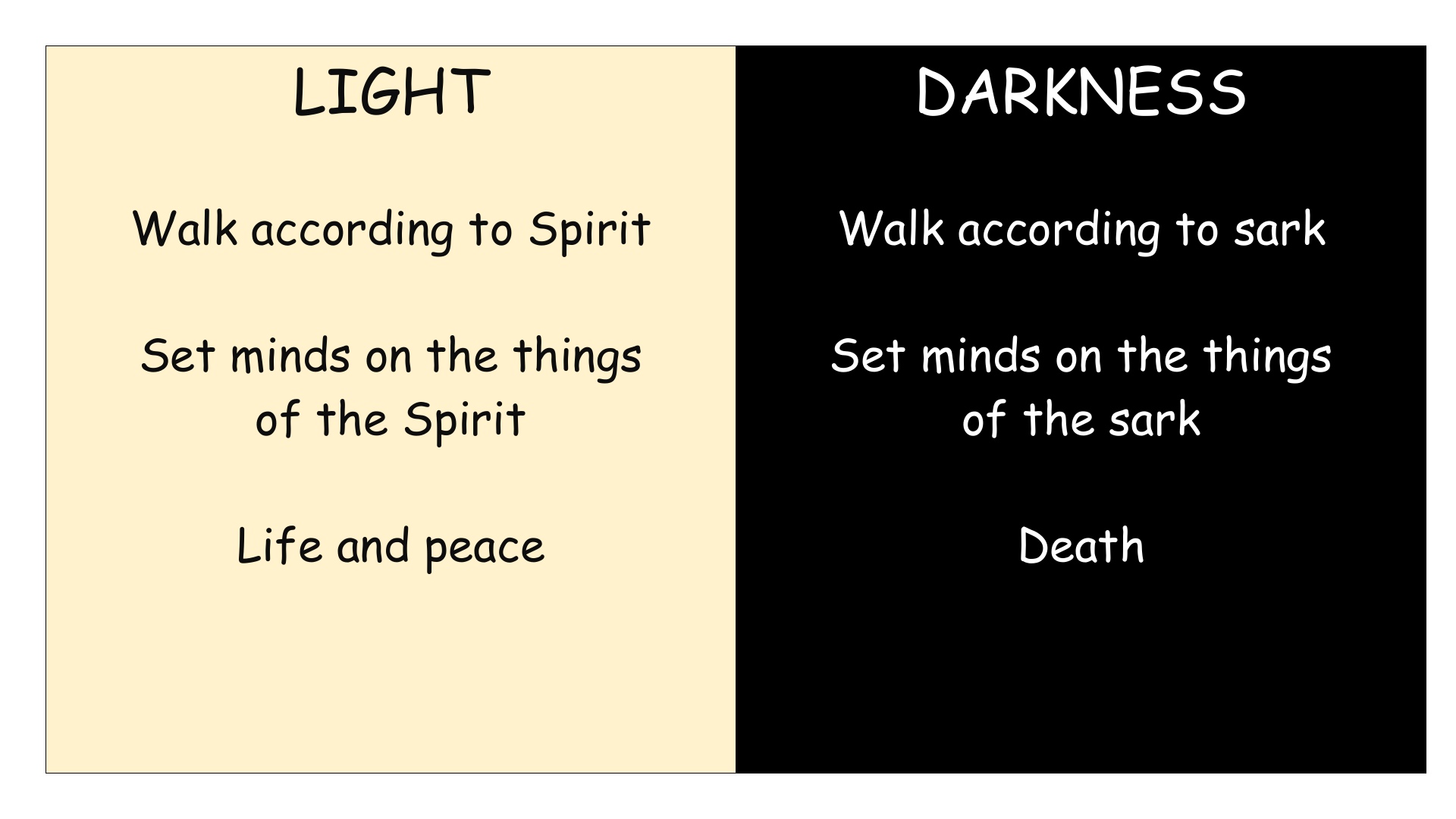
Here is the chart we worked on in home church that Sunday morning.
It shows some of the contrasting things God has taught us over the years. I
would be happy to explain any of them. However, the encouragement is to do
something like this for yourself, identifying the contrast between how you
would live if your identity is “light in the Lord”, and how this gets
sabotaged by accepting a ”darkness” identity instead.
This chart adds the truths of Paul’s teaching about this where
he clarifies the differences between walking in the Spirit or walking in the
flesh (what we refer to as the “sark”) in Romans 8.[1] It
makes the issue about where we “set” our minds.
While this vlog-post is a very short summary of what we
looked at regarding our identity as God’s children of light, I encourage you to
open your heart to ask God to show you any ways you perceive yourself as
darkness and ask him to lead you to know him as the light of the world so you
can know what it feels like to be light in him.
If that means you need to receive Jesus Christ as your Lord
and Savior because you have never received his light, this is encouragement for
you to do just that. If you discover that you are living out of a wrong belief
about who you are in Christ, and hurting yourself with negative thoughts, beliefs
and feelings that have no place in the child of God, this is encouragement to
take hold of what is already yours in Christ and live out who you are as “children
of light”.
And, if you need help knowing how to do all this, either
talk to someone you know who is a child of God through faith in Jesus Christ,
show them what I have shared here, and ask them to help you know God like this,
or send me an email and I would be happy to share this good news with you.
Whatever the case, please let the words of Jesus Christ settle into your heart
so you can know who you are to the Creator as one of his children.
When we think of answers to prayer, we
often look outside ourselves to what we wish God would do in circumstances or
people around us.
However, before we see those kinds of
answers, praying the way Jesus taught does a work in us. And, it is that work
in us that prepares us for any other ways he works in fellowship with our
prayers.
Our home church is in the early steps of
exploring the Disciples Prayer, commonly called the Lord’s Prayer.[1]
As I have incorporated this model into my praying, it is doing a wonderful work
of directing my thoughts to the most important things in the world, and so
encouraging me to pray even more earnestly in things that are clearly the will
of God.
In this Vlog post I share a few minutes
worth of testimony of how praying as Jesus instructed is life-changing in both
the praying, and the expectation of how God will answer such prayers.
And remember, if you join in, please share
your testimony of what God does with you as you pray according to his will.
I’m working on praying my way through the
Disciples’ prayer of Matthew 6:9-13,[1]
and the last couple of days the introductory statement to this section has
captured my attention.
1 “Beware of practicing your righteousness
before other people in order to be seen by them, for then you will have no
reward from your Father who is in heaven.” (Matthew 6)
Here is a six-minute Vlog post sharing a bit
of my encouragement from these words of our Savior, hoping that it will
encourage you as well.
Some church conflicts
could be avoided if we clarified words and meanings so we all understood which
ones were according to sound doctrine[1]and which were contrary to God’s word.
Such is the case with
the terms Peacekeeper and Peacemaker. One is biblical, the other is not.
I want to clarify
that, just because a contemporary issue or situation is described with words
that are not found in Scripture does not necessarily mean that what someone
teaches about those things is unbiblical.
For example, some
terms we don’t find in the Bible include eating disorders, drug addictions,
dissociative disorders like PTSD, or hormonal influences like PMS.
However, in the same
way as Jesus applied sound doctrine to circumstances and life experiences that
were not found in the Bible of his day,[2]the church can apply the truth of God’s word to contemporary experiences so that
we are living by every word that comes from the mouth of God now even as Jesus’
disciples did then.[3]
In this five-minute
Vlog post we consider what it means to be a peacekeeper in contrast to a
peacemaker, and how to join God in the only one that accords with the sound
doctrine of his word.
[2]Remember that the
Scriptures available at the time of Jesus’ earthly ministry were those we now
refer to as the Old Testament. It should encourage us greatly that he helped people
with all kinds of things that were not directly described in those Scriptures,
and yet everything Jesus did to help those people were described in God’s word,
albeit with a lot of applications that baffled even the most learned of his
contemporaries.
We may not have much
say over how we are treated by our families, but God has a lot to say about
what we can experience with him when our families discard us.
During Jesus’ ministry
he warned that those who follow him may experience rejection, disowning, and
even violence from family members. We know that in our day some who come to
faith in Jesus from various religious backgrounds lose their families, and even
face death threats and attempts on their lives from family members.
By my teen years, I
was well aware that there would be a family-cost to following Jesus. I just couldn’t
escape who Jesus is, and what he has done for me, and what it will mean to face
him one day, and so I was graciously compelled to learn how to follow Jesus while
always asking God how to honor him in family relationships.
I know that we can’t
choose the story we are given by others, but we can grow a testimony of
trusting God no matter what anyone else has done, or threatens to do.
With that in mind,
there is a testimony in God’s word of someone dealing with broken family
relationships in a way that honors God as our loving adoptive Father. I have my
own story of how God has become a Father to me in a long journey through family
hurts and heartaches, and I would like to share hope and encouragement for anyone
still on the journey.
This Vlog sharing is
to encourage anyone whose family relationships have left them feeling all alone
to get to the know the heavenly Father who would love to be with us always.
Here's my first step in trying out vlogging (video-blogging).[1]My aim is to share a key thought from God's word to encourage us in how he
speaks to us today and leads us through anything we are facing.
If you have been unable to fit in a daily time with God in his word, or
you could use an extra dose of encouragement, it's only 7 minutes to consider
what God is speaking through his Book.
In this case, do you think that reading God's word might just happen to
change your mind about something? It happens to me on a regular basis. And,
since he's much smarter than me, that's always a good thing!
In an earlier post I had expressed some thoughts about how men can open our hearts to the
experiences of women who are dealing with violence and abuse from their
childhoods, and/or from present life-experiences. Some of the trauma felt by
women hits too close to home, and some is taking place half a world away. Both
can make men feel helpless.
Here is a song we can sing to God as a prayer that will help men in the
praying, women in our caring, and the work of God in answer to prayer. There is
healing for the brokenhearted, and binding up for our wounds (Psalm 147:3), so
let's unite to pray for more of what God is already willing, able, and eager to
do.
This is my first attempt at a Vlog (video blog). Any helpful ideas are quite welcome. I hope that a few minutes of considering God's word will be helpful to you as well.
In this first Vlog-post, I address a common problem that comes up when Christians begin discussing their differing interpretations of Scripture. I also focus on one particular Scripture that would provide a lot of help to us, if we would put it into practice when division is in the works. God promises to help when we practice his will.