Pages

Showing posts with label Praying Scripture. Show all posts

Wednesday, July 9, 2025

On This Day: Stephen’s Prayer for Saul’s Forgiveness

   Then they cast him out of the city and stoned him. And the witnesses laid down their garments at the feet of a young man named Saul. And as they were stoning Stephen, he called out, “Lord Jesus, receive my spirit.” And falling to his knees he cried out with a loud voice, “Lord, do not hold this sin against them.” And when he had said this, he fell asleep. And Saul approved of his execution. (Acts 7:58-8:1)


   Sometime in the past couple of weeks, someone posted another stereotypical post about Christians only having two options in dealing with how we relate to those who wrong us. One option is always presented as forgiveness (even if the person hasn’t repented), the other option is always presented as anger or bitterness. Since we all know we shouldn’t give room for sinful anger or bitterness, we are tricked into thinking we must then choose to forgive people who have never repented of what they have done.

   When I ask people who believe this where in the Bible do we have an example of God, the prophets, Jesus, or the apostles forgiving someone who is clearly unrepentant, I am never given a text where this is shown. I can show multiple examples of unrepentant people not being forgiven, but there isn’t one example where a person is unrepentant about their sin but is forgiven anyway.

   However, there are two Scriptures that are claimed as proof that we are to forgive unrepentant people. One is when Jesus from the cross prayed, “Father, forgive them, for they know not what they do.” The other is when Stephen was dying and he prayed, “Lord, do not hold this sin against them.” I am told that this was them forgiving their enemies. And, because I just came to Stephen’s prayer this morning, it seems timely to once again share some very liberating insights.

   My response to the claim that Jesus and Stephen were forgiving their enemies is always something to the effect of, “Read it again.” If the texts were telling us that Jesus and Stephen were forgiving their persecutors, the wording would need to be from Jesus, “Father, I forgive them…”, and from Stephen, “Lord, I do not hold this sin against them.”

   The wording by both Jesus and Stephen is prayer. They are both talking to “our Father in heaven”, and they are both praying for their persecutors. When we realize Jesus DID instruct us to pray for our persecutors, and we see that this is what Jesus was doing, we can back up a bit and ask ourselves what it would look like for us to pray for our enemies like that.

   Back in 1993, I was introduced to the concept of “freedom in Christ”. I was on the verge of heading through one of the most painful valleys of my life as childhood trauma and abuse came leaking out of my people. I began to see how many Scriptures spoke of God doing things for us that I had not seen him doing in me or others, and I felt a longing to experience God the way I was learning in his word.

   In the 3+ decades since then, it has become clear to me why it is so important to show people the difference between praying that God would forgive someone (like Jesus and Stephen did) and just forgiving them even if they haven’t repented (which can’t be found in Scripture). When we know that God never forgives people until they repent, then our prayer for their forgiveness is with the understanding that people “presume on the riches of his kindness and forbearance and patience, not knowing that God's kindness is meant to lead you to repentance”.

   Why do we need God’s kindness leading us to repentance if we are forgiven without repenting? If all our sins are cancelled without repenting, why did Jesus say that “repentance for the forgiveness of sins should be proclaimed in his name to all nations, beginning from Jerusalem” (Luke 24:7)? There is no forgiveness anywhere in the Bible without repentance.

   It is very liberating for abused and traumatized people to understand that no one is forgiven until they repent. Their abusers, their persecutors, their enemies, will not be forgiven unless they repent. If we pray for God to bless them, he won’t answer that prayer without humbling them to repentance first.

   So, instead of these victims cringing at the feeling of injustice with the “just forgive” mantra that can’t be found in the Bible, they can let God lead them into his grace where they truly want God to reach those people with his love and mercy because they have no hope until they repent and are forgiven.

   And when we can truly pray for these people that God would forgive them, and we know this can only happen if they repent, we are able to accept God’s will in this because we can allow ourselves to want these people to experience God’s kindness leading them to repentance just as we experienced for ourselves.

   I know I am in the minority when I show these things from God’s word. If you’re not convinced, I’m still waiting for someone to show me a scene in Scripture where someone is clearly unrepentant and either Yahweh or his prophets in the Old Testament, or Jesus and his apostles in the New Testament, forgave the unrepentant person who was continuing in sin. In all my times through the Bible, I have not come across one instance of this.

   To encourage me in this viewpoint of Stephen’s prayer for his persecutors (not him forgiving his enemies), I found this comment from William Hendriksen in his commentary on Acts 7. He wrote,

Reflecting on the death of Stephen and Paul’s consent, Augustine made this penetrating comment:
    “If Stephen had not prayed,
    the church would not have had Paul.”[1]

Augustine (and William Hendriksen with him) saw that Stephen’s prayer, “Lord, do not hold this sin against them,” is linked to our introduction to sinful Saul, who became the beloved apostle Paul. When we continue down the road and see how God’s kindness brought Paul to repentance, we can see how Stephen’s prayer was answered in God’s gift to Paul of repentance and faith.

   For me, this hit the bull’s eye of my heart today, not as a way to win a debate on the topic of “to forgive or not to forgive”, but to realize that I have “Sauls” in my life who need me to pray for their forgiveness. I know God will only answer that prayer by leading them to repentance (I have lots of Beatitudinal Valley illustrations to go along with this), and I know I want them to experience that mercy from God as I have on so many occasions.

  Ultimately, we do not pray to make God do something our way. Our praying is to line us up with God’s will. God leading me to pray this way is his will, and it is up to him if I ever see the answer. Stephen did not see his prayer answered that day because he died just seconds later. But seeing Paul’s arrival in eternity some decades later (whatever that feels like in the spiritual realm) would have been an experience of joy filled with praise to God.

   Today, I will pray in hope and praise in confidence. God will work it for good, and I might live long enough to see some of my Sauls reconcile with both God and his people. In the meantime, praying the way Jesus and Stephen did keeps my heart free, and that’s what the people in my life need from me each day. 


© 2025 Monte Vigh ~ Box 517, Merritt, BC, V1K 1B8

Email: in2freedom@gmail.com

Unless otherwise noted, Scriptures are from the English Standard Version (The Holy Bible, English Standard Version. ESV® Text Edition: 2016. Copyright © 2001 by Crossway Bibles, a publishing ministry of Good News Publishers.)


[1] Kistemaker, S. J., & Hendriksen, W. (1953–2001). Exposition of the Acts of the Apostles (Vol. 17, pp. 281–282). Baker Book House.

Friday, June 27, 2025

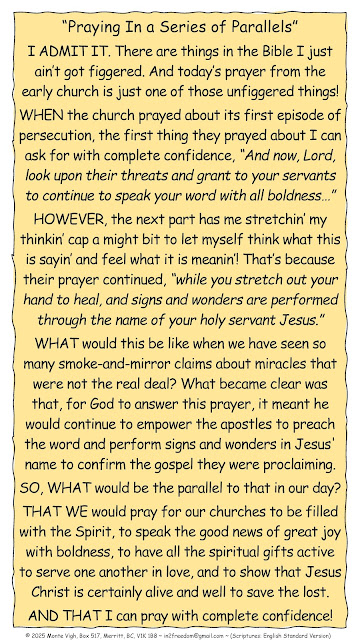
On This Day: Praying In a Series of Parallels

   And now, Lord, look upon their threats and grant to your servants to continue to speak your word with all boldness, while you stretch out your hand to heal, and signs and wonders are performed through the name of your holy servant Jesus.” (Acts 4:29-30)

   When we read the history recorded in God’s word, our application of the word must be careful not to assume that what happened back then must happen now. A favorite illustration of this is Moses’ burning bush experience. That was history. It was not teaching us we need to go out in the wilderness and have our own burning-bush experiences.

   When I consider how the early church prayed about their first episode of persecution, I am immediately free to let myself pray and expect that God will give us boldness to continue making Jesus known in our increasingly hostile world.

   But when it comes to signs and wonders, there is such a mix of claims and fears about this that it requires some honest praying about our own hearts in relation to God’s word. This is because we usually hear the fights between the two extremes on the matter of signs and wonders and spiritual gifts. One side of the pendulum-extreme claims that God doesn’t work that way in our day. The other pendulum-extreme claims that God’s miraculous activity in the church is a three-ring circus where even the devil is welcome to make things happen.

   My concern is to find the parallel between what God was doing in the early church through his apostles and what it is supposed to look like now when God is doing his work through all the members of the body of Christ.

   In other words, the book of Acts revolves around how Jesus laid the foundation for the church through the apostles. You can read all about this in Ephesians 2 where Paul describes the apostles as the foundation of the church, Jesus as the cornerstone, and the rest of us as the blocks that make up the structure of the spiritual temple that is “a dwelling place for God by the Spirit.”

    So, the parallel to the boldness the early church prayed for is that we would be just as bold in continuing to proclaim the good news of the kingdom of God in our day.

   However, the parallel to the early church seeing signs and wonders being done through the apostles is that we want God to work in our churches using all the spiritual gifts described in the New Testament (on God’s terms) so that the church Jesus is building on “the foundation of the apostles and prophets” is showing the same evidence of Jesus’ presence through the Holy Spirit that people will “declare that God is really among you” (I Cor 14:25).

   And with that, it should be obvious why this must be a matter of PRAYER!!!

   The opportunity for Satan to use such a glorious prayer to divide Christians is well-documented. The experiences of losing fellowship with people because of their rules about what the Holy Spirit is allowed or not allowed to do in our churches are painful memories reminding us of our weaknesses. Self-protection rules some who cannot bear the thought of God doing something they can’t control. Self-glorification rules others who must be in the spotlight even if they need to fabricate mirages of signs and wonders when God is not the least bit impressed with their pride.

   As I receive God’s word this morning, it is with a sense that I must let God lead me into his will about this, and I must pray with all my heart for God’s activity in his church to be just as evident now as it was in the early days of the church. Jesus is still building his church. The gates of hell still cannot prevail against what Jesus is building. Satan is fulfilling what Scripture warned about him that he would steal, kill, and destroy God’s work wherever people will let him.

   With all that in mind, Jesus’ church prays for the Triune God to be glorified in us, among us, and through us, so people know that Jesus Christ came into the world to save sinners. And, when Jesus saves sinners, he saves them into the fullness of life, a life that must be pursued in prayer so our hearts are ready to attach to God in whatever he shows us he is doing.


© 2025 Monte Vigh ~ Box 517, Merritt, BC, V1K 1B8

Email: in2freedom@gmail.com

Unless otherwise noted, Scriptures are from the English Standard Version (The Holy Bible, English Standard Version. ESV® Text Edition: 2016. Copyright © 2001 by Crossway Bibles, a publishing ministry of Good News Publishers.)


Thursday, November 28, 2024

On This Day: The Pendulum and the Plumbline on Prayer

   And James and John, the sons of Zebedee, came up to him and said to him, “Teacher, we want you to do for us whatever we ask of you.” And he said to them, “What do you want me to do for you?” And they said to him, “Grant us to sit, one at your right hand and one at your left, in your glory.” (Mark 10:35-37)

   But whoever would be great among you must be your servant, and whoever would be first among you must be slave of all. For even the Son of Man came not to be served but to serve, and to give his life as a ransom for many.” (Mark 10:43-45)

   It really stood out to me today how comfortable Jesus’ disciples were with him. For James and John to be able to ask such a self-centered request not only exposed their immaturity, but it also demonstrated something of what it was like to spend so much time with our Savior. They felt safe to ask him such a thing even though they had no clue what they needed to learn.

   Because this is the most “real and personal” picture of prayer (talking to Jesus in person), it calls us to clarify the difference between pendulum prayers that swing from one extreme to another and plumbline prayers that are always expressing “truth in love” from the heart of “spirit and truth” worshipers. 

   The way Jesus prayed in the Garden of Gethsemane is the most amazing demonstration of how we can pray earnestly about personal experiences we are going through while also submitting our thoughts and feelings to God’s will. 

   In fact, what hit me the most in James and John’s request was that it had the sense of a teenager who imagines they know better than their parents what they need and so they are quite adamant that it needs to be done their way (it also sounds like toddlers who think everything is about them, but I’m giving the brothers the benefit of the doubt).

   I have found the Psalms to be a very good source of prayer-examples about how to pour out our hearts to God about everything we are going through, telling him everything we need to get out about what we think and feel, but then submitting it all to the will of God and praising him for whatever he chooses to do with us. 

    In Psalm 73, Asaph gives his testimony of how close he came to stumbling because he fell into the trap of envying the wicked for how much better their lives seem to go than for those who pursue righteousness. He even admitted that “When my soul was embittered, when I was pricked in heart, I was brutish and ignorant; I was like a beast toward you” (Psalm 73:21-22). 

   But after pouring out his heart in “the sanctuary of God” (vs 17), Asaph remembered what was ahead for the wicked and reminded himself what was ahead for him on the path of truth and righteousness. And so he praised God, “Whom have I in heaven but you? And there is nothing on earth that I desire besides you. My flesh and my heart may fail, but God is the strength of my heart and my portion forever” (vss 25-26).

   Today’s word from God is to bring all our requests to him, not in a “would you do things my way” kind of praying, but in a humble expression of our needs with humble submission to his will. 

   After all, Father knows best, and we can only be like our Savior if we want “not my will, but yours be done”. 


© 2024 Monte Vigh ~ Box 517, Merritt, BC, V1K 1B8

Email: in2freedom@gmail.com 

Unless otherwise noted, Scriptures are from the English Standard Version (The Holy Bible, English Standard Version. ESV® Text Edition: 2016. Copyright © 2001 by Crossway Bibles, a publishing ministry of Good News Publishers.)


Tuesday, April 23, 2024

The Harmonies of God’s Coming Kingdom

THE MORE I meditate on what it means to pray, “your kingdom come,” the more layers of meaning come to the surface of my mind. And just now, at this moment, I heard them in harmony. 

WHAT I MEAN is that there are so many different thoughts about God’s kingdom coming, and so many ways it affects everything about life, and for a moment (in my early morning brain fog) I was struggling to try to hold on to all the thoughts. But suddenly I was hearing them all at the same time without any discord in my mind. They were in harmony. They blended into one beautiful expression of God’s rule and reign over the universe and filled my heart with hope about how to pray for God’s kingdom to come, and how to live in light of this coming. 

SO, WHAT harmonies of the kingdom do I hear this morning? 

I HEAR the “good news of great joy” that God has given us his Son to be the Savior of the world. I hear the “gospel of the kingdom”, that “the time is fulfilled, and the kingdom of God is at hand,” so we must “repent and believe in the gospel”, or, “repent and believe the good news” of the kingdom of God’s beloved Son!  

I HEAR the wonderful good news that the blessings of God are seen in the poor in spirit, and those who mourn, and the meek, and those who hunger and thirst for righteousness, and the merciful, and the pure in heart, and the peacemakers, and those who are persecuted for the sake of the righteousness of Jesus’ kingdom. 

I HEAR that the righteousness of Jesus’ kingdom makes his brothers the salt of the earth and the light of the world. I hear Jesus singing out how the righteousness in his kingdom exceeds the righteousness of the religious elite, the religious hypocrites who do all their good deeds for show. The righteousness of Jesus’ kingdom is a real, genuine experience of the activity of God in our hearts. God gives us the new hearts he promised to the prophets. We can now be righteous by faith in Jesus Christ in ways that could never happen by keeping laws and rules, even the very best system of laws and rules the world has ever known, what is now the old covenant. 

I HEAR how the stanza of the song of the kingdom is now playing out the glorious harmonies of how to pray according to the righteousness of faith so that we are filled with the knowledge that our heavenly Father knows everything we need before we ask him for a thing, and so we are not going to babble on in prayer hoping our many words will get us what we want, but we attach to “our Father in heaven,” and then ask that his name would be hallowed, honored, and revered in our lives, that his kingdom would come both now and at the end of the age, and that his will would be done here on earth in the same ways it is done in heaven. 

AND BECAUSE we are those who are always seeking first the kingdom and righteousness of God instead of the things of the world, we ask him to “give us this day our daily bread” knowing that he will give us what we need, sometimes through our own employment, and sometimes through the sharing of the body of Christ. We pray that the church would be a place where we are always confessing our sins to one another (however it is needed where we have wronged someone or they have wronged us) so that we keep being forgiven as we keep on forgiving. And we are always seeking God to “lead us not into temptation, but deliver us from evil”, or from the evil one and his evil ways. 

I ALSO HEAR the harmony of how Jesus concludes his Sermon on Mount where he gives the illustration of the wise and foolish builders. I hear the beautiful sound of the wise builder who hears Jesus’ words and puts them into practice, and I hear the mournful sounds of the foolish builder who hears Jesus’ words but does not      put them into practice, and so I know how to pray that God’s kingdom would come to us in power and glory so we would be known as those who love to do God’s will just like Jesus. 

AND I HEAR the realities of the new covenant that tell me that there is also a future aspect to the coming of God’s kingdom. I know that God has already “made us a kingdom, priests to his God and Father,” and that we are to live accordingly right now in every aspect of our lives. But I also know that we are always waiting for Jesus’ “appearing and his kingdom”. We are looking forward to when we will have our “entrance into the eternal kingdom of our Lord and Savior Jesus Christ” in a way that can only happen at Jesus’ return when he comes to judge the lost and gather the elect to himself. 

I HEAR how Jesus could say as with one set of instruments in the orchestra, “And behold, I am with you always, to the end of the age”, and with another set promise, “Surely I am coming soon”! to which the rest of us harmonize with our brother John, “Amen. Come, Lord Jesus!”

MY POINT is that God’s kingdom is always coming. It is coming near to people all the time through the presence of the church Jesus is building, and through the ongoing proclamation of the “good news of great joy” that God has given us his Son, our Savior, Jesus Christ our Lord. 

BUT GOD’S KINGDOM is still to come. It is coming. It is on its way. It has not yet arrived. The final consummation of all God’s work in the coming of Jesus Christ is yet to happen, and we are constantly asking Father, “your kingdom come!” “Come, Lord Jesus!” 

OH, AND one more thing: you and I are adding our own harmonies to Jesus’ teaching on prayer. If we are in Christ, we are equipped with new hearts and new minds and new life that is fully able to pray as Jesus instructed. We can pray from our new hearts with the righteousness of faith that wants everything Jesus taught in his model prayer. When we pray it, it is our prayer. It is our harmony to the “golden bowls full of incense, which are the prayers of the saints.” 

AND EVEN if we all were to pray the exact words of Jesus’ model prayer all at the same time, guess what: it would sound like the most beautiful harmony in the world to hear the voices of “a great multitude that no one could number, from every nation, from all tribes and peoples and languages, standing before the throne and before the Lamb, clothed in white robes, with palm branches in their hands, and crying out with a loud voice, ‘Salvation belongs to our God who sits on the throne, and to the Lamb!’”

AND SO, we pray as Jesus taught. We pray this model prayer in our own words, describing our own situations and circumstances, praying each request for the people in our lives, and the things we are going through, so that all our thoughts and prayers rise up to the Father in harmony with one another so that our Father in heaven is always hearing us praying together that his name would be hallowed, and his kingdom would come, and his will would be done on earth as it is done in heaven, and that he would provide the daily bread for all his children throughout the whole world, and that he would forgive us our sins as we confess them to him just as we forgive everyone who confesses their sins to us, and that he would lead us not into temptation but deliver us from evil and the evil one, because, after all, HIS is the kingdom, and HIS is the power, and HIS is the glory for ever and ever, Amen! 

SO, LET’S raise our crescendo of prayer like we believe and know that everything Jesus taught us is TRUE!


© 2024 Monte Vigh ~ Box 517, Merritt, BC, V1K 1B8

Email: in2freedom@gmail.com

Unless otherwise noted, Scriptures are from the English Standard Version (The Holy Bible, English Standard Version. ESV® Text Edition: 2016. Copyright © 2001 by Crossway Bibles, a publishing ministry of Good News Publishers.)


Friday, February 16, 2024

The Delightful Newness of Level Ground Faith

I first knew about God 58 years ago. I have been growing to know him better ever since. 

One of the advantages of age is that it humbles a guy with the awareness that things I once thought I had all figured out in my younger years were saturated with childish immaturity that didn’t even know how much I didn’t even know! 

In my knowing-God-much-better-than-I-used-to stage of life I can now appreciate and marvel at things I am still learning in a genuine getting-to-know-God kind of way. 

For example, just in the last couple of weeks I came to realize that picturing God’s children coming to the level ground in front of the throne of grace is vastly superior to what I had thought for decades about the level ground at the foot of the cross. 

Fact is that people only come to the level ground at the foot of the cross once. That is when they understand the good news of great joy that God sent his Son to be their Savior, they feel God’s kindness bringing them to repentance, and they know that Jesus Christ died for them, was buried, and was raised from the dead to be their Lord and Savior forever. 

At that place at the foot of the cross they are “delivered… from the domain of darkness and transferred… to the kingdom of his beloved Son, in whom we have redemption, the forgiveness of sins.” The cross became the door by which they enter the kingdom, and they never need to go back to the cross for anything because it has already given them EVERYTHING! 

Instead of coming to the level ground at the foot of the cross, I now see that we come to the level ground at the throne of grace. Every child of God comes here. All believers have the same “great high priest who has passed through the heavens, Jesus, the Son of God”. All Jesus’ disciples have the same level-ground calling to “hold fast our confession.” And the reason for the level-ground at the throne of grace is that, in the negative, “we do not have a high priest who is unable to sympathize with our weaknesses,” and, in the positive, we have “one who in every respect has been tempted as we are, yet without sin.” 

And so, as the level-ground continues, God invites all his children to, “with confidence draw near to the throne of grace, that we may receive mercy and find grace to help in time of need.” 

The “throne of grace” is level ground because God is pure holiness. It is his throne. It is his grace. He relates to each of his children based on the cross, but the cross that has brought us to his throne. 

God’s “mercy” is level ground because it is MERCY!!! He always shows mercy to all his children all the time. The cross has already told us that every child of God has already experienced the mercy of God pouring out his wrath against our sin on his Son. Because of this, God can freely and fully show mercy to every one of his children in a level-ground kind of way since we are all forgiven, cleansed, and adopted in the exact same salvation. We all entered the kingdom through the same door, which is faith in Jesus Christ crucified. 

And all God’s children will “find grace to help in time of need” because with our Father in heaven there is no favoritism, no injustice, no partiality, no bribery, no blindness, no busyness that can’t see what is going on. 

Instead, God’s grace is the grace of the holy God who knows all, sees all, loves all his children, knows the most intimate realities of our secret hearts, and has both the wisdom and knowledge to do what is absolutely best for each of his children, always working everything in each of us for the greatest good of making us more like Jesus Christ his Son. 

I share this because I had another dream about a third person who needs to reconcile with me. As I was praying through Psalm 51 for them, particularly asking God to lead them to pray this prayer of repentance for themselves, I was again reminded that the level-ground I long for with them is at the foot of the throne of grace where we will all receive the grace, and mercy, and help we need to walk in the “obedience of faith” in reconciliation. 

It wasn’t just the reminder that this level-ground that we once found at the foot of the cross already led us to the level-ground at the throne of grace, but also the awareness of a humble maturing within me that has only happened through meeting with God in his word and prayer almost every day for over thirty years. 

I simply found myself smiling with the knowledge that I now know something that hadn’t occurred to me until just a couple of weeks ago, and now it has transformed the way I think of Christians reconciling in the level-ground of the kingdom of God, the level-ground that welcomes every child of God to the throne of grace where we all will always receive the mercy, grace, and help that God deems the perfect fit with whatever we are going through each day, including whoever we need to reconcile with to the glory of “our God who sits on the throne, and to the Lamb!” 

Is there any fellow believer you need to reconcile with, perhaps someone who has been unwilling to even consider their need to repent to you for what they have done? I highly recommend going to the throne of grace in intercession, and using David’s prayer of repentance in Psalm 51 to ask God to do for them what David prayed for himself, and even to lead them to pray this prayer of repentance for themselves so they will meet you at the level-ground before the throne of grace where all believers are helped to reconcile with God and each other to the glory of the Savior who died on the cross to make such things possible.


© 2024 Monte Vigh ~ Box 517, Merritt, BC, V1K 1B8

Email: in2freedom@gmail.com

Unless otherwise noted, Scriptures are from the English Standard Version (The Holy Bible, English Standard Version. ESV® Text Edition: 2016. Copyright © 2001 by Crossway Bibles, a publishing ministry of Good News Publishers.)


Thursday, February 15, 2024

The Return to Joy of a Willing Spirit

I recently woke up in the early morning from a very good dream about someone wanting to reconcile with me. It had such an emotional effect that I had to immediately get out of bed and pray for this person. As I did so, I was drawn to David’s prayer of repentance in Psalm 51 and realized that this is what I needed to pray for them in the hope that my dream would turn into reality. 

However, it is impossible to pray Psalm 51 in an intercessory way (bringing the needs of others before God with the hope of bringing God’s grace and goodness to others) without first praying it in a humbly repentant way for us first. 

Since then (about 9 days), I have begun each morning with prayerful meditation on David’s prayer, praying it for myself as needed in the branch-of-the-vine kind of way,[1] and then praying it for the person who had reconciled with me in my dream, and anyone else I can think of who would be blessed to experience David’s prayer of repentance for themselves. 

My meditation has settled into asking for three things. First, that God would do for me whatever David prayed for himself. Second, that God would do for others what David and I prayed for ourselves. Third, that God would lead others to pray each of these prayer requests for themselves the way David and I prayed them. The aim is that God would answer their prayers with as much gracious blessings as David and I could wish for ourselves. 

With that as background, I am up to this request in David’s prayer: 

Restore to me the joy of your salvation,

    and uphold me with a willing spirit. (vs 12) 

Let’s look at how we can pray about this in the three ways we are considering. 

QUESTION 1: What are we asking God to do for us when we pray this for ourselves?

We must begin with the admission that we have lost the joy of God’s salvation and become weak and demoralized about what we have done. David had already addressed how he couldn’t hide from his sin, he knew God was blameless in any judgment he meted out, he could feel his sin as a curse from conception, and he was desperate to know that God would “cast me not away from your presence, and take not your Holy Spirit from me” (vs 11).

When he prayed this “restore” and “uphold” prayer, he was asking God to let him have back the things he had lost because of his sin. He could not erase the sin from history, as much as he wished it could happen (he likely had no idea that people 3,000 years later would still benefit so much from his prayer), but he could call on the God of “steadfast love” and “abundant mercy” (vs 1) to restore what he had destroyed and repair what he had ruined. 

When we pray this for ourselves, we freely admit to God how our joy has taken such a beating because of our sins that we have fallen prey to a spirit within us that struggles to be willing to walk in the righteousness of faith. As a distressed father of old pleaded with Jesus, “I believe; help my unbelief!” we can pray, “I am willing; help my unwillingness!” 

I often find myself on a Beatitudinal Journey through whatever God is teaching me. As I walk through the eight Beatitudes Jesus used to introduce his Sermon on the Mount, I see a fresh valley of blessings pouring into my life, helped along by my meditation on how they apply.[2]

I can see how the “poor in spirit” admission that I have lost joy because of sin and fallen pray to an unwilling spirit because of iniquity is God’s blessing to lead me to honest repentance. The blessing continues as I express myself as one of “those who mourn” and enter the blessing of God’s comfort through forgiveness. When I interact with God in acknowledgment that I cannot fix myself but rest in the authority of Jesus Christ to save me from my sin, I find the blessing of meekness that knows I am a joint heir with Christ of all that is his. And when I find myself “hungering and thirsting for righteousness” no matter how horrible my sin, I know I am being blessed with the satisfaction of righteousness that is mine only by grace through faith. 

That is what I see in David’s prayer, that God would restore to him the joy of his salvation and uphold him with a willing spirit. David had arrived at the bottom of the Beatitudinal Valley where God could satisfy him with the super-abounding grace that restores sinners from our horrible experiences of sin into a life where “the righteous shall live by faith” once again (David’s sin was a faith problem after all). And I know God is just as loving and gracious to answer this prayer for me as he was to return David to joy and restore his broken and contrite spirit. 

QUESTION 2: What are we asking God to do for others as we pray this prayer for them in an intercessory way?

The first test in praying this for others is whether we are in the “blessed are the merciful” experience where we want God to be just as merciful to people who have wronged us as we expect him to be with us in our wrongdoing. We will also discover whether we are in the “blessed are the pure in heart” reality where we want only one thing, that God would be glorified in all of us as we all find our satisfaction in him. We will also know whether we are blessed as a “peacemaker” by our heart’s desire in asking God to do for people who have wronged us the same return to joy and willing spirit as we have experienced for ourselves. And we will know we truly want the same thing for others as ourselves when we are willing to be blessed as one of those who “are persecuted for the sake of righteousness” even while we pray for our persecutors as Jesus instructed. 

If we have truly prayed David’s prayer for ourselves, knowing that “where sin increased” in us, “grace abounded all the more” for us,[3] We will be just as eager to see God restore to our church-going opponents the joy of his salvation as he has returned us to joy more times than we could ever deserve, and we will want him to be just as gracious in upholding them with a willing spirit as we have felt him do for us more times than we can count. 

QUESTION 3: What are we asking God to do for others as we intercede for them that they would pray this prayer for themselves? 

When we pray for others, it never means God will just do what we ask for them without engaging them in a relational way. 

For example, once we know that the Bible never teaches us to forgive unrepentant people, when we obey Jesus’ command to pray for our persecutors, and we take up his prayer from the cross, “Father, forgive them,” we know that God cannot and will not answer that prayer without bringing them to repentance. 

When we obey Jesus’ command to “bless those who curse you,” our prayers for our cursing opponents cannot be applied except in the Beatitudinal way Jesus presented. He can only bless a cursing person by bringing them to see their poverty of spirit that is making them such a miserable person. He can only bless them by leading them to mourn what they are doing. He must bless them with the meekness that surrenders to the authority of Jesus Christ and hungers and thirsts for the righteousness of being like Jesus. 

In other words, Jesus taught us to seek what is best for others (that’s what agapè-love is all about), and to answer our prayers he will always engage with a person in a relational way that leaves them aware that they are dealing with the living Christ and must humble themselves and receive the good news with great joy and thanksgiving.

With all that in mind, it isn’t enough for us to pray for sinning people that God would return them to joy and build up their spirits. We must pray that God would show such kindness to them that would lead them to repentance so they would call on him to restore to them the joy of his salvation, and to uphold them with a willing spirit. We must ask God to bring them to the place of praying this prayer for themselves just as we have prayed it for ourselves. We want them to know God as the gracious and loving Savior who has forgiven them just as we have come to know him by letting David mentor us in how to pray. 

So many church-folk have no idea how to live in “the joy of your salvation” because they have never really prayed in repentance and faith. They languish with an unwilling spirit because they have never confessed how desperately they need God where they have so horribly sinned. 

The cure is to meet with God in David’s prayer so we know the joy of restoration and forgiveness for ourselves and then actively seek the same experiences for others, including the personal repentance and faith that attaches to God in everything we go through. 

The fact that God led David in his prayer, and then led his people to include David’s prayer in the Bible, means that it is God’s will that we be restored to the joy of his salvation after any sin, and it is God’s will to uphold us with a willing spirit. If we will take this kind of praying to heart for ourselves, we are already doing the same thing we want God to do for someone else. 

And so, we keep praying for ourselves and others according to the word and will of God and wait expectantly for God to do God-sized things in all our lives that were once nothing but a dream.  


© 2024 Monte Vigh ~ Box 517, Merritt, BC, V1K 1B8

Email: in2freedom@gmail.com

Unless otherwise noted, Scriptures are from the English Standard Version (The Holy Bible, English Standard Version. ESV® Text Edition: 2016. Copyright © 2001 by Crossway Bibles, a publishing ministry of Good News Publishers.)


[1] John 15:1-11 is where Jesus spoke of himself as the vine and us as his branches. His emphasis was on our need to abide in him in order for us to bear much fruit. This means we always deal with how we are doing in our walk with God first, and then look at how he wants to bless others out of that abiding attachment to him. It is easy to apply this to David’s prayer as we make sure we are caught up on everything we need there for ourselves and then asking God to do the same things for others as we seek God to do for us.

[2] Matthew 5:1-12 (in context of the whole Sermon on the Mount from Matthew 5-7)

[3] Romans 5:20

Thursday, February 8, 2024

A Hope-filled Prayer for Cleansing

WHEN SIN entered the world, Adam and Eve immediately felt guilt, shame, and fear. The horror of that moment, that they had sinned, that the curse of death would now be upon every child they would bear, and that it was impossible for them to fix it, can only be imagined in those moments when we have done the unthinkable and know we cannot take it back.

HOWEVER, within minutes, God revealed the lifeline for the whole human race. God promised that a particular “offspring” of the woman “shall bruise” the serpent’s head (authority) while the serpent “shall bruise his heel.” In other words, God would send a Savior through the woman, born of a virgin, who would absolutely defeat sin, death, hell, the grave, and Satan himself, but through suffering in our place for our sin. 

DAVID’S PRAYER was, “Purge me with hyssop, and I shall be clean; wash me, and I shall be whiter than snow.” David is using some delightful rhyming thoughts here. “Purge me with hyssop (a medicinal plant)” rhymes with “wash me”. “I shall be clean” rhymes with “I shall be whiter than snow.” 

DAVID KNEW the horror of being convicted of sin that can never be taken back. There is no way we can do enough good to undo our sin because our sin already makes us guilty of violating God’s law and we are all without excuse. 

THE ONLY HOPE is cleansing. David understood his need then, and we must understand our need now. “For there is no distinction: for all have sinned and fall short of the glory of God,” and “the wages of sin is death”. Period. 

EXCEPT THAT Jesus is the one “in whom we have redemption, the forgiveness of sins.” Why in Jesus and only in him? Because “for our sake God made him to be sin who knew no sin, so that in him we might become the righteousness of God.” Jesus suffered God’s judgment against our sins so we could receive God’s righteousness in our place. And the righteousness of God is as clean as it gets. 

HERE IS God’s promise: “If we confess our sins, he is faithful and just to forgive us our sins and to cleanse us from all unrighteousness.” That is the new covenant way of asking for what David poured out from his heart, the cleansing from sin that only comes through faith in Jesus Christ our Lord.


© 2024 Monte Vigh ~ Box 517, Merritt, BC, V1K 1B8

Email: in2freedom@gmail.com 

Unless otherwise noted, Scriptures are from the English Standard Version (The Holy Bible, English Standard Version. ESV® Text Edition: 2016. Copyright © 2001 by Crossway Bibles, a publishing ministry of Good News Publishers.)


Friday, September 8, 2023

Morning Sharing: To Pray God’s Word with Longing

I’ve reached a point of saturation in the whole supplementing my faith with self-control focus (II Peter 1:3-15) and have way too much to share on Sunday! So, I went instead to my focus on Jeremiah 1 from my prayer time yesterday morning.

My prayer-chapel:

At my prayer-chapel yesterday, praying through Jeremiah 1 was such a heart wrenching mixture of grief and comfort. The grief was because of wounds and heartaches from people, and the comfort was in the invitation to know God as so different from humans! I was so aware of the longing to hear God say to me the same things he said to Jeremiah, and so I spent some time focusing on that this morning.

Here’s just the first thing that stood out: 

“Before I formed you in the womb I knew you,

and before you were born I consecrated you;

I appointed you a prophet to the nations.”

(Jeremiah 1:5)

The first line (“Before I formed you in the womb I knew you”) I can affirm as true for me as much as for Jeremiah. When Paul spoke of “those God foreknew”, it means those God personally knew and loved before creation. Every believer in Jesus Christ can affirm that before we were even conceived, God already knew us for real.

The second line (“and before you were born I consecrated you”) also seems applicable to all believers in the sense that our place in the body of Christ would have been determined by God before we were born. It emphasizes that each of us is given the place in the body of Christ God has chosen for us, therefore we must live it out as people set apart to do what we are gifted to do.

And, the third line (“I appointed you a prophet to the nations.”) is more of a fill-in-the-blanks statement where we can replace “prophet” with whatever we know of our gifting and our place in the body of Christ and let ourselves feel the significance that our Father in heaven appointed us to this place for the good of people around us. This carries with it the weight of responsibility that, to fully be ourselves, we must be what we have been appointed to be.

When I prayed this through out at my prayer spot yesterday, there was a lot more emotion pouring out than this morning. Part of that was the way just praying through God’s word surprises us with whatever God says next.

At the same time, I am glad to meditate on this again today and see how it will encourage you as well. It is a wonderful encouragement to live out who and what we are in the body of Christ today as faithfully as Jeremiah and the other prophets fulfilled their assignments in the kingdom of God in their day. And God will speak to us through his word about what he is doing with us as surely as he did for them.


© 2023 Monte Vigh ~ Box 517, Merritt, BC, V1K 1B8

Email: in2freedom@gmail.com

Unless otherwise noted, Scriptures are from the English Standard Version (The Holy Bible, English Standard Version. ESV® Text Edition: 2016. Copyright © 2001 by Crossway Bibles, a publishing ministry of Good News Publishers.)


Monday, June 26, 2023

Morning Sharing: A Prayer for an Empty Spirit

I love Sunday mornings (yes, I know it is Monday morning when I am sharing this) because being in a home church means I have extra time to go for a prayer walk, listen to our “church prep” sermon,[1] and arrive out at my outdoor prayer chapel for some time of praying through God’s word. 

For weeks I have been praying my way through Isaiah as a way to increase my understanding of the context of chapter 49, the one I am prayer-journaling (meditating) through. This is the verse I shared in church yesterday from Isaiah that captivated me as I prayed it back to God: 

“and the spirit of the Egyptians within them will be emptied out,”[2] 

This brought to mind a number of people who have led the way in churches regarding the idolatry of self-protection. I was warned about this idol of self-protection over thirty years ago, and three decades has proven the warning valid! 

The above scripture makes it easy to understand how to pray about such things. The “spirit of the Egyptians” is the enemy spirit, the spirit of rebellion against God. Egypt represents both the quintessential enemy of God that had once held his people captive, but also one of the lovers his people kept turning to for help and refuge instead of to him as their God. 

This is the issue with self-protection in the church: it holds God’s people captive, and it is their favorite idol of refuge when they are afraid. The promise of God regarding the Egyptian spirit is definitely valid for today! 

My meditation on this brought to mind people who have had such a spirit of idolatry (including sacrificing others on the altar of their self-protection), that it was not difficult to understand how to ask God to confound the fellowship of these idolaters and cause such fighting among them that they will completely lose the courage of this spirit of rebellion in them.[3] 

But then I found myself praying about this through the Beatitudes Jesus used to introduce his Sermon on the Mount[4]. I prayed that God would: 

·         “Bless them with poverty of spirit so they would open their hearts to you,

·         “And bless them with mourning over their sinful idolatries and cruelties so they would feel your comfort soothing the wounds that have driven them to desperation,

·         “And bless them with the meekness that is so aware that nothing inside them can protect them and help them, and no idol they worship of matter, or man, or demon, can deliver and save them, and bring them to rest in the sovereignty and authority of Jesus Christ our Lord so they are able to seek to know and do your will,

·         “And bless them with such a hunger and thirst for righteousness, O God, that they would know they are emptied of their Egyptian spirit, and void of the righteousness of God they have forsaken, and that they see in Jesus Christ such grace and glory and goodness that they believe the good news that there is a righteousness that is by grace through faith, that you made Jesus who knew no sin to be sin for us in order that your people could become the righteousness of God in Christ,

·         “And bless them with such an experience of this grace and mercy of God that they would be transformed from mean to merciful, and from cruel to compassionate, and from rebellious to reconciliatory,

·         “And bless them with such a profound experience of the righteousness of God that is by grace through faith, and such an amazement and wonder at how good and loving and gracious you are, that their hearts would be purified with first love so they would be all about the kingdom and righteousness of God in everything they do,

·         “And bless them with such an experience of the peace of God in their salvation that they become the most loving and relentless peacemakers who want everyone in their lives to have peace with God instead of the praise of man, and would unite with other believers to make the Prince of peace known through the Gospel of peace so others will come to experience being ‘justified by faith’ so they ‘have peace with God through our Lord Jesus Christ’ along with us all,

·         “And bless them with the grace of persecution for their righteousness in Christ that is so strong, and pure, and wonderful, that Satan aims his attacks against its unstoppable power and glory so that they would come to rejoice with us in the persecution we all share in Jesus’ name where they were once Satan’s pawns in that persecution!” 

I hope that helps and encourages you to see how praying scripture back to God gives us confidence that we are praying things that are God’s will, but also that we are praying in context of the life of the kingdom of God that is always seeking God’s best for others in the agapè-love (divine love) that wants God’s glory and people’s good to magnify God’s grace, love, mercy, forgiveness, restoration, and reconciliation in every answer to our prayers.


© 2023 Monte Vigh ~ Box 517, Merritt, BC, V1K 1B8

Email: in2freedom@gmail.com

Unless otherwise noted, Scriptures are from the English Standard Version (The Holy Bible, English Standard Version. ESV® Text Edition: 2016. Copyright © 2001 by Crossway Bibles, a publishing ministry of Good News Publishers.)


[1] For a number of years, we have helped our church families set our minds on spiritual things prior to arriving at our church fellowship by viewing in our own homes a sermon video by a variety of pastors. This not only helps us prepare ourselves spiritually for fellowship and worship, but it also gives us input and counsel from far more pastoral voices than we have in close contact.

[2] Isaiah 19:3

[3] This is the context of Isaiah 19, that God was describing how he would get the Egyptian territories fighting one another in confusing resulting in the Egyptian spirit being brought to nothing.

[4] Matthew 5:1-12

Monday, May 8, 2023

To Be a Learner of God’s Peace

    All this is today is an effort to glorify God for his exceedingly good grace in speaking to his children through his word.

   As I am sure you know, I do not agree with those on the one pendulum-extreme who claim that God doesn’t speak to his children today, and I don’t agree with those on the opposite pendulum-extreme who claim that God speaks today with thoughts and ideas in people’s’ minds that are like new revelations of scripture.

   However, God speaking to his children is all through his word, and it is through his word that he continues to speak to us today. I picture it like my heavenly Father taking me on his lap with his word open before me and directing my attention to what he has already written so he can show me how that will work in my life today. The more we receive our daily lessons from the word like it is God speaking to us, the more we will know the Holy Spirit doing exactly what Jesus promised:

   “When the Spirit of truth comes, he will guide you into all the truth, for he will not speak on his own authority, but whatever he hears he will speak, and he will declare to you the things that are to come.”[1]

  So, to the point: I have been on an incredible journey through Isaiah 54. It has felt slow in some ways, and hugely and overwhelmingly fast in others. Going one-verse-at-a-time is like covering chapters of God’s thoughts and knowing we would learn more every time we returned.

   At the same time, I have gone to my prayer-spot in a gulley just outside of town and prayed through chapters of Isaiah at a time, pouring out my heart to God about what I am reading, how it ministers to me, how it convicts me, what I need, what I want for me, what I want for others, and I am in awe of God’s gift of grace and love to me.

   This morning, I travelled into this beautiful verse:

   All your children shall be taught by the LORD (Yahweh),

    and great shall be the peace of your children.[2]

   If you are following what the world is doing to the children of this generation for their harm, and the way the world is inventing evil against children just as scripture prophesied,[3] doesn’t your heart thrill with the thought of joining God in such a work as this? Don’t you want this for children in your life (young and old) that would have “great peace” if only they were taught by God?

   It gets even better!!!

   The word “taught” isn’t a verb, as in emphasizing God’s action of doing the teaching. He does that, but it isn’t the emphasis here. The word is actually a noun, which means it is telling us what kind of people these children are; they are “the learned”.

   We know what it is like to try to teach something to someone and they just don’t get it, or they refuse to learn it, or they don’t have the capacity to receive it. But God chose a word here that indicates that the children are learners.

   In other words, the meaning is that the generation of children God is talking about would be active “learners” of Yahweh-God, and because God’s active teaching would enter their hearts, and they would learn it for real, God’s peace will rest upon them, and within them.

   It is as God had already said in Isaiah:

   “You keep him in perfect peace whose mind is stayed on you, because he trusts in you.”[4]

   This is what God wants, and his prophecy was that the children following that generation would become learners of Yahweh-God (contrary to their parents who refused and rebelled against everything), and they would come into God’s peace as promised.

   As I meditated further on the word “taught” I found this verse a bit earlier:

   The Lord GOD (Yahweh) has given me the tongue of those who are taught, that I may know how to sustain with a word him who is weary. Morning by morning he awakens; he awakens my ear to hear as those who are taught.[5]

   Again, being “those who are taught” means those who have learned. Look at the picture: Isaiah had a relationship with God in which he woke every morning to hear from his Father in heaven. His ear was awakened to hear while the majority of his nation refused to listen. He knew he was one of “those who are taught”.

   And because of this, he knew that God had “given me the tongue” of a learned one. Can’t you see Jesus’ imagery of the vine and the branches, that if we abide in him as a branch in the vine, we will bear much fruit?[6] Isaiah felt that what he had received from God had so filled him that he was “learned-up”, so to speak, and it was now flowing out of him so his tongue was passing on the learning whether or not that generation would listen. He was one of those “who are taught”, and so he had to speak what he knew as one of the ways Yahweh-God would teach it to others.

   There is so much more, but all of this attached to a verse that stood out to me at my prayer-spot yesterday, something we shared in home church time:

   But this is the one to whom I will look: he who is humble and contrite in spirit and trembles at my word.[7]

   What a gift of grace! Those who are “learned” of Yahweh-God are not the religious elite, or those who can understand the Hebrew, Greek, and Aramaic of the original Bible manuscripts, or those who can answer the questions on a catechism without fail, or those who can win a Bible-verse quiz (as good as any of those things may be). Rather, the ones God looks to as those who will be his “taught-ones” are humble in their hearts, contrite within their spirits, and tremble with awe and wonder at the words our God speaks to us.

   My encouragement in sharing this is that any of us can be the people God is talking about. Jesus said:

   “My sheep hear my voice, and I know them, and they follow me.”[8]

   Don’t be sheepish (sorry!). When you hear Jesus’ voice, praise him for that! Thank him for knowing you (because you know you could never have known him if he did not know you first[9]). And follow him in whatever he is saying. Don’t be one who is actively taught but never learns (Jesus warned about that when he was here the first time[10]). Be the wise man, “who hears these words of mine and does them”.[11]

   Because, when we hear and do, we never know how our words and deeds will be the way God turns someone else into one of those children who are taught by the Holy Spirit of Yahweh-God and experience his peace that surpasses understanding.


© 2023 Monte Vigh ~ Box 517, Merritt, BC, V1K 1B8

Email: in2freedom@gmail.com

Unless otherwise noted, Scriptures are from the English Standard Version (The Holy Bible, English Standard Version. ESV® Text Edition: 2016. Copyright © 2001 by Crossway Bibles, a publishing ministry of Good News Publishers.)


[1] John 16:13

[2] Isaiah 56:13

[3] Romans 1:30

[4] Isaiah 26:3

[5] Isaiah 50:4

[6] John 15:5 (context is John 15:1-17)

[7] Isaiah 66:2

[8] John 10:27

[9] I John 4:19

[10] Matthew 13:13

[11] Matthew 7:24 (in context of the wise and foolish builders in Matthew 7:24-27)